Inside the GST Welding Workshop: Four Lines, One QC Standard
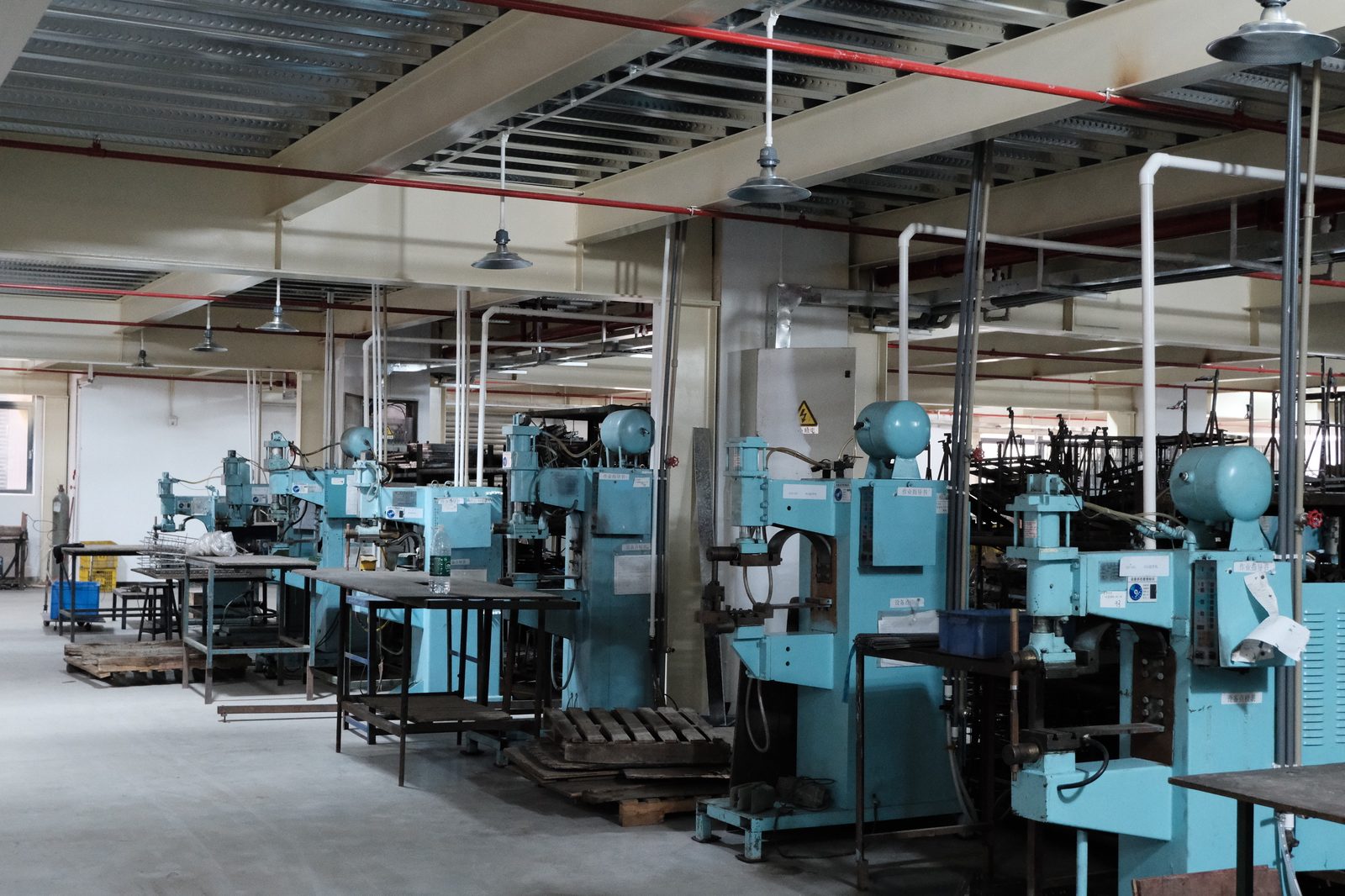
Most of what determines whether a pull-out basket survives ten years of daily use happens at the welding station. It is also the step most commonly subcontracted by trading companies. At GST it has stayed in-house since 2005, and this update explains how that part of the plant is organised.
Four lines under one roof
The welding workshop in our Zhongshan base runs four parallel lines. Each line handles a defined product family — base cabinet baskets, corner units, tall pantry frames, and hanging racks — so operators build familiarity with a narrow set of geometries instead of switching setups all day.
Every station carries a posted work instruction sheet (作业指导书) and an equipment status card. Both are part of our ISO 9001 documentation, and both are visible in any factory visit or video walkthrough.
What the operator controls
Resistance spot welding looks simple from outside, but the operator is managing three variables on every joint:
- Current and dwell time — set per material. Low-carbon steel wire for chrome-plated lines and 304 stainless take different parameters; the same setting on both produces a weak joint on one of them.
- Electrode condition — worn electrodes spread the contact area and drop joint strength. Electrodes are dressed on a fixed schedule rather than when a problem appears.
- Fixture seating — a frame that is not square in the fixture stays not-square after welding. Sub-assemblies are checked against a fixture before they move on.
Why we do not subcontract this step
When welding is outsourced, weld quality becomes a purchasing decision instead of a production decision. Problems surface at the customer, not on the line. Keeping welding in-house means a failed loaded-cycle test traces back to a specific line, a specific shift, and a specific parameter set — and gets corrected the same week.
What this means for buyers
If you are evaluating suppliers, ask to see the welding floor rather than the showroom. Ask which steps are done in-house and which are bought in. Ask how weld parameters are recorded per material. Those three questions separate factories from trading companies faster than any certificate.
We are happy to walk any serious buyer through this workshop, in person or on a video call.